

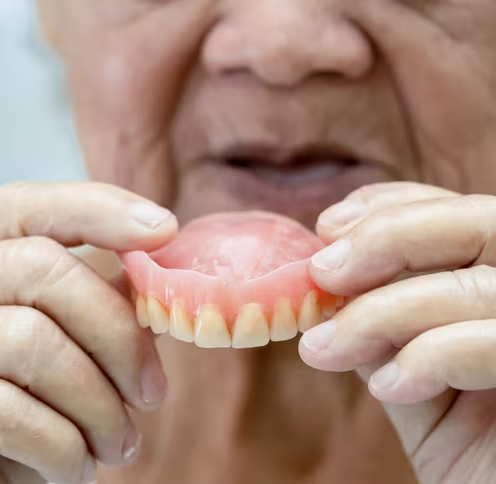
Complete Dentures to Rebuild Your Smile
Losing all of your natural teeth affects more than just your smile. It can change the way you eat, the way you speak, and even the shape of your face over time.
As part of our general dentistry services, our team designs custom complete dentures. These removable appliances replace an entire arch of missing teeth on the top, bottom, or both, using suction and the natural contours of your mouth to stay securely in place. A well-fitted denture can closely resemble your natural teeth, restoring your ability to eat and speak comfortably while helping preserve the natural shape and structure of your face.
Conventional vs. Snap-On Overdentures
A conventional complete denture rests on the gums and stays in place through suction and the natural shape of your mouth, while a snap-on overdenture attaches to a small number of dental implants placed in the jawbone for a more secure, stable fit. Both options replace a full arch of missing teeth, but they take very different approaches to get there.
Because a snap-on overdenture requires implant placement, this option involves coordination with our periodontics team. If you are interested in learning more about the implant-supported option, our snap-on overdentures page covers that process in more detail, and our team can help coordinate care between both sides of the practice if that route is the better fit for you.
Reasons to Consider a Complete Denture
-
Restores Your Ability to Eat
Missing all of your natural teeth can make chewing difficult, limiting the foods you can eat. A complete denture restores your bite so you can enjoy a fuller range of foods again.
-
Supports Clearer Speech
The loss of natural teeth can affect how certain sounds and words form when you speak. A complete denture fills that space, helping restore a more natural and confident way of speaking.
-
Preserve the Shape of Your Face
Without teeth to provide structure, facial muscles can begin to sag over time, changing the shape of your face. A complete denture helps support your natural facial contours and appearance.
What to Expect During Your Treatment
Getting a complete denture involves several steps to make sure your final appliance fits comfortably. Here is what generally happens along the way.
-
Step 1:
Evaluating Your Mouth
Dr. Reem examines your gums and jaw to determine the right type of complete denture for your situation.
-
Step 2:
Taking Impressions
Impressions and measurements of your jaw are taken to design a denture that fits the unique shape of your mouth.
-
Step 3:
Designing Your Denture
Your complete denture is custom-made at a dental lab, designed to closely resemble your natural teeth and fit the contours of your gums.
-
Step 4:
Fitting the Denture
Once your denture is ready, Dr. Reem checks the fit and makes any needed adjustments so it sits comfortably and securely.
-
Step 5:
Adjusting to Your Denture
It is normal for a new denture to feel a little awkward at first, with some minor irritation or increased saliva flow while your mouth adjusts.
-
Step 6:
Follow-Up Care
Follow-up visits allow Dr. Reem to check the fit of your denture and make any adjustments needed as your mouth continues to settle.
Rebuild Your Smile With Complete Dentures
Losing all of your natural teeth does not mean losing your smile. Dentures can help restore your appearance and make it easier to eat and speak, and most new denture wearers adjust comfortably within a few weeks as their mouth becomes accustomed to the fit.
If you want to explore whether a complete denture is the right option for you, our team is here to walk you through the process. You can contact our office to schedule your visit and start building a plan that fits your smile and your timeline.
Ready to explore complete dentures in Magnolia?
Our Magnolia office is accepting new adult patients. Call us today or book online.
Request An AppointmentFrequently Asked Questions
What are complete dentures and who needs them?
Complete dentures are removable prosthetic appliances that replace all of the teeth in an arch when no natural teeth remain. They restore the ability to chew, speak clearly, and smile with confidence, and also provide support for the lips and cheeks. Patients who have lost all their teeth due to decay, gum disease, or injury may be candidates for complete dentures.
How long does it take to get complete dentures?
The process typically involves several appointments over a period of weeks. Impressions and measurements are taken, a trial denture is evaluated for fit and appearance, and adjustments are made before the final denture is fabricated. If teeth need to be extracted first, some healing time will be required before final impressions can be taken. We will walk you through the full timeline at your consultation.
What is the difference between conventional and immediate dentures?
Conventional dentures are made after the remaining teeth are removed and the gums have healed, which takes several weeks. Immediate dentures are placed the same day teeth are extracted, so you are never without teeth during healing. However, immediate dentures typically require more adjustments over time as the gum tissue changes shape during healing, and may eventually be relined or replaced.
Will dentures affect how I eat and speak?
There is an adjustment period, typically several weeks, during which eating and speaking may feel different. Starting with softer foods and cutting them into smaller pieces can help while you adapt. Most patients find that their speech and chewing ability improve significantly once the muscles of the cheeks and tongue learn to work with the dentures. Adhesives can also help during the early adaptation period.
How do I care for complete dentures?
Dentures should be removed and rinsed after eating, brushed daily with a soft brush and denture cleaner, and soaked overnight in water or a denture solution to keep them from drying out. Your gums, tongue, and palate should also be cleaned daily with a soft brush. Regular dental checkups are still important for monitoring your gum health and the fit of the denture.
Do dentures ever need to be replaced?
Yes. Over time, the bone and gum tissue beneath the denture changes shape, which can cause the denture to fit less securely. Most complete dentures need to be relined, rebased, or replaced every five to seven years. If your denture feels loose, causes sores, or no longer fits well, come in so we can assess whether a reline or new denture is the right solution.